Visual Magnitude Calculator — Model Validation
A comprehensive overview of the photometric formulas, satellite illumination phase functions, and optical sensor models powering the application.
1. Stellar Visual Magnitude Baseline
Visual magnitude ($m_v$) is a logarithmic scale representing apparent brightness as viewed from Earth. The baseline reference is calibrated using standard solar flux and bright stellar benchmarks such as the Orion constellation.
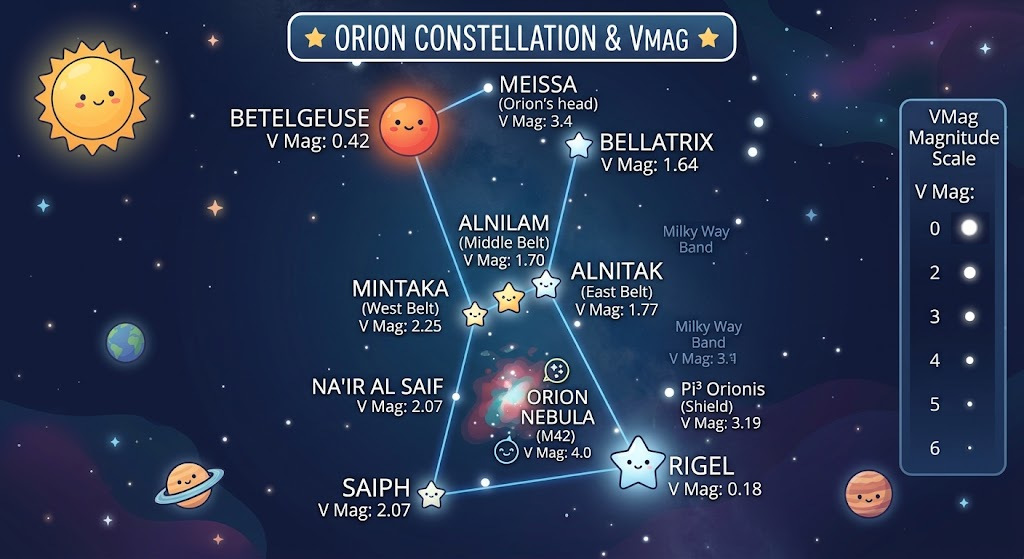
The standard visual magnitude formula relating received irradiance $E$ to a standard reference $E_0$ is expressed as:
$$m_v = -2.5 \log_{10}\left(\frac{E}{E_0}\right)$$2. Target Photometry & Lambertian Sphere Model
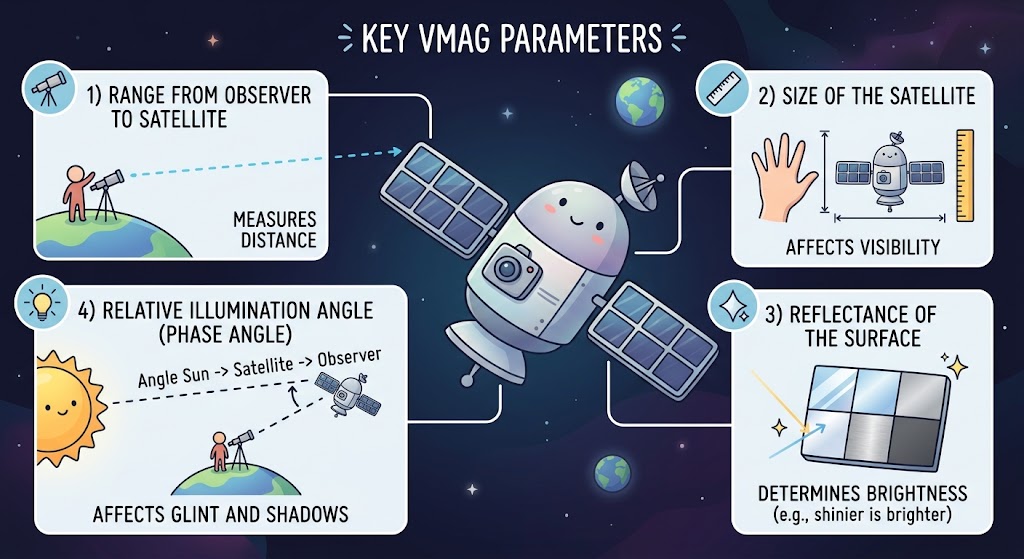
Calculating the visual magnitude of an artificial satellite requires accounting for range, cross-sectional area, material albedo, and sun-target-observer geometry.
Lambertian Sphere Illumination Model
Assuming a diffuse spherical satellite (Lambertian surface) of radius $r$, cross-sectional area $A = \pi r^2$, surface reflectivity $\rho$, at range $R$, and phase angle $\phi$ (angle between Sun-Satellite and Satellite-Observer vectors):
$$F(\phi) = \frac{2}{3\pi} \left[ \sin\phi + (\pi - \phi)\cos\phi \right]$$The calculated solar irradiance reflected toward the observer $E_{\text{sat}}$ is given by:
$$E_{\text{sat}} = E_{\text{sun}} \cdot \rho \cdot \frac{A}{R^2} \cdot F(\phi)$$Where $E_{\text{sun}}$ is the exo-atmospheric solar irradiance constant in the visible waveband.
3. Sensor Payload & Photon Capture Model
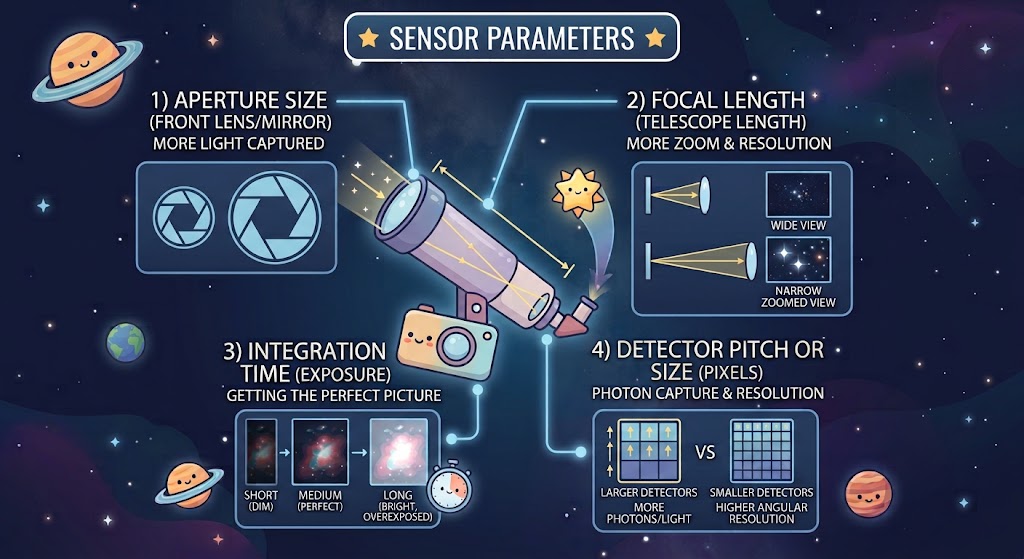
Once the target irradiance at the aperture is known, the optical sensor model estimates total detected photons and system angular resolution.
Total Photon Capture Calculation
The total collected photons $N_{\text{photon}}$ received during integration time $t_{\text{int}}$ across aperture diameter $D$, optical throughput $\tau$, and detector quantum efficiency $QE$ is calculated as:
$$N_{\text{photon}} = \left( \frac{E_{\text{sat}}}{h \nu} \right) \cdot \left( \pi \frac{D^2}{4} \right) \cdot t_{\text{int}} \cdot \tau \cdot QE$$Where $h$ is Planck's constant and $\nu$ is the mean central optical frequency.
Angular Resolution & Spatial Metrics
- Diffraction Limit (Rayleigh Criterion): $\theta = 1.22 \frac{\lambda}{D}$ (radians)
- Detector Instantaneous Field of View (IFOV): $\text{IFOV} = \frac{p}{f}$ (radians), where $p$ is detector pitch/size and $f$ is focal length.
4. Wavelength Adjustments & Results Export
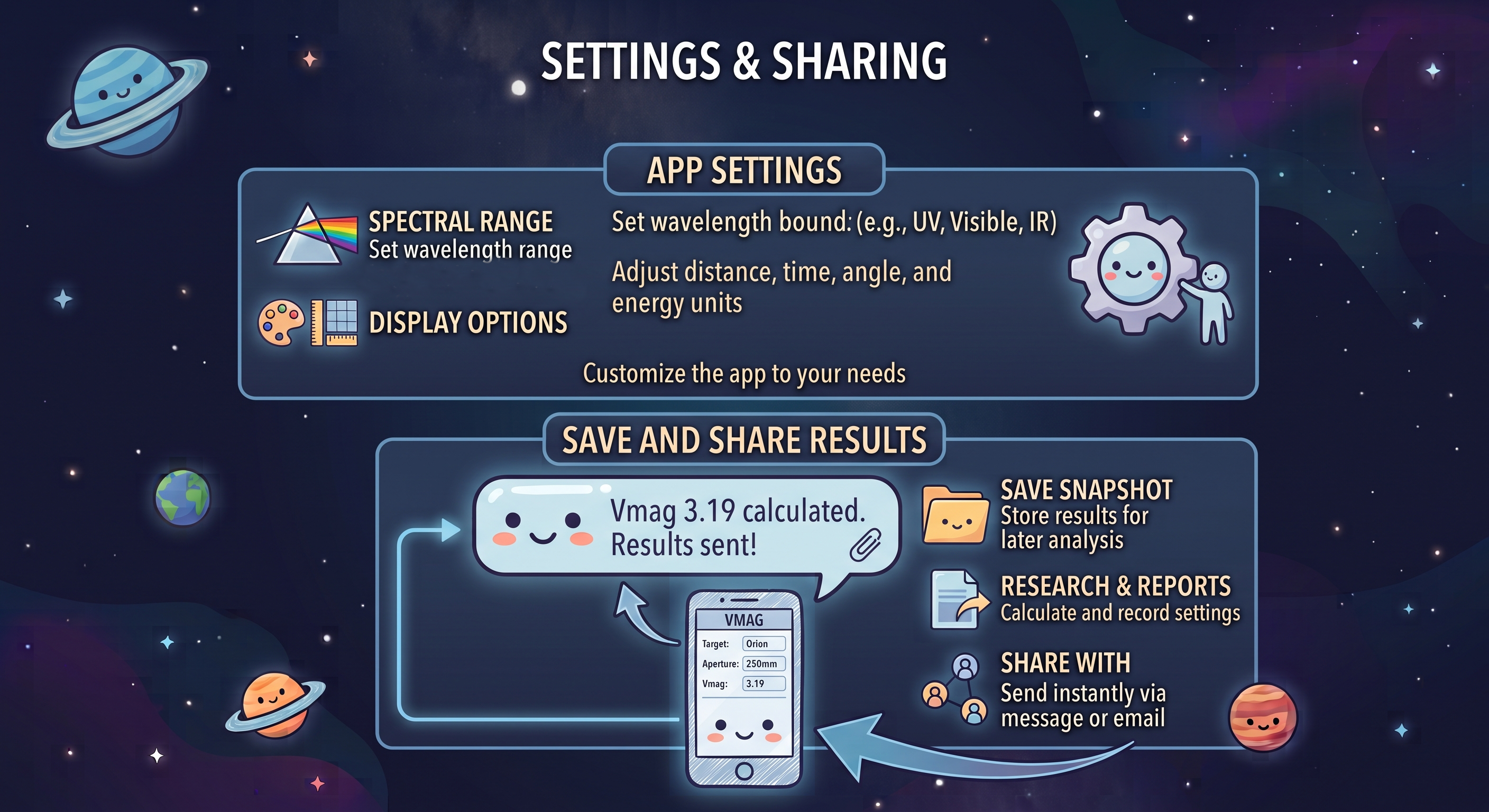
The Visual Magnitude Calculator allows real-time adjustments across custom spectral passbands (e.g., Visible, Near-IR), unit toggles, and snapshot logging to support field reporting and space domain awareness research.